

Quartz, Automatic, Mechanical, Chronograph Watch: The Complete Guide

A watch movement is a bit like a car engine: it makes everything run inside, but you rarely see it. Yet it's what decides whether your Olevs watch will be accurate to the quarter second, whether it needs a battery, or whether it winds itself as you move your wrist.
There are four main families at Olevs: quartz, automatic, mechanical, and chronograph watches. Each works differently, and each suits a different way of wearing a watch.
First, how do you pick the right movement?
You don't need to be a watchmaking expert to make the right call. Just ask yourself these questions:
- Are you the practical, no-fuss, zero-maintenance type? Quartz is for you.
- Do you like the idea of a watch that "lives" through your own movement, never needing a new battery? Automatic will suit you.
- Do you enjoy winding your watch each morning, like a small ritual? A manual-wind mechanical watch is for you.
- Do you also want to time something, like a race? Look for a chronograph model, whatever its base movement.
Once you know what you're after, head to the Men's Watches collection or the Women's Watch collection to filter by style.
Now, let's compare the four movements
Here's a simple table so you can see the differences at a glance:
| Movement | Accuracy | Maintenance | Price at Olevs | Best for |
|---|---|---|---|---|
| Quartz | Very accurate (±15 seconds/month) | Almost none, just a battery change now and then | €47 to €65 | Everyday wear, zero hassle |
| Automatic | Good (±20 seconds/day) | Wear it often, or use a watch winder | €70 to €110 | Lovers of fine mechanics |
| Mechanical (manual wind) | Good (±20 to 30 seconds/day) | Hand-wound, almost every day | €65 to €100 | Those who enjoy the ritual |
| Chronograph | Depends on the base movement | Also depends on the base movement | €55 to €120 | Sporty style, stopwatch function |

Now, how does it actually work inside?
Quartz is the easiest to understand: a small battery sends current through a tiny quartz crystal, which vibrates at an incredibly steady rate. That vibration moves the hands forward. That's why it's so accurate — and why so many quartz watches come at a friendly price.
A mechanical watch has no battery at all. Inside, a spring is tensioned when you wind the crown (the small knob on the side). That spring then releases its tension slowly, and this energy drives a mechanism made of dozens of tiny parts. It's a genuine piece of watchmaking that runs thanks to you.
An automatic watch is a cousin of the mechanical watch, but smarter: instead of you winding the spring by hand, a small weight inside swings every time your wrist moves, and that motion winds the spring on its own. That's why people say it "lives" with you — if you leave it sitting still for too long, it eventually stops, and you'll need to wind it again.

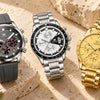
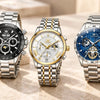
The chronograph isn't really a separate movement: it's an added function on top of a quartz or automatic movement. It lets you time something precisely using small subdials on the face, started by the pushers on the side of the case. An Olevs chronograph watch is therefore either a quartz watch with a stopwatch function, or an automatic one with it.
The questions we get asked most
Does an automatic watch stop if I don't wear it?
Yes, after roughly 24 to 48 hours of being still, the power reserve runs out and it stops. Just wind it by hand a few turns, or give it a gentle shake, to get it going again.
Why are quartz watches cheaper than automatics?
Because they have fewer mechanical parts to make and hand-assemble. The craftsmanship an automatic watch requires takes longer and is more delicate, and that's reflected in the price.
Does a mechanical watch lose time?
A little, yes — that's normal, even on luxury watches. At Olevs, expect a 20 to 30 second drift per day, which is entirely reasonable for a watch at this price point.
Can I wear a chronograph every day?
Absolutely. It's mostly a matter of style: chronographs often have a busier dial, with several subdials, which gives them a sporty look that's popular for everyday wear.
When should I change the battery in a quartz watch?
A battery generally lasts one to two years depending on use. The most common sign it's time for a change: the second hand starts moving in two- or three-second jumps instead of one.
Is an automatic watch a good fit for someone new to watches?
Yes, as long as you're happy with a small ritual: wearing it regularly, or hand-winding it now and then if it's been sitting unused. That "living" quality is exactly what draws in so many curious beginners.
How can I tell which movement my watch has without opening it?
Watch the second hand: if it moves in small, sharp ticks, one second at a time, it's a quartz movement. If it glides smoothly with no ticking, it's mechanical or automatic. The product page always states the movement type too.
Want to compare specific models directly? Check out our guide on men's mechanical watches, or our detailed mechanical vs. automatic comparison. And to pick your model, head to the Automatic Watch collection or the Mechanical Watch collection.