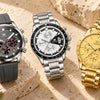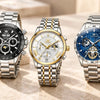


Chronograph Watch: How to Choose the Right One

The chronograph belongs to the family of complication watches, alongside the automatic and mechanical watches covered in our complete guide to Olevs movements. A complication, in watchmaking, is any function added on top of simply telling the time — and timing is historically the most common one of all.
First, how to use a chronograph correctly
On almost every Olevs chronograph, two pushers sit on either side of the crown:
- The top pusher (2 o'clock position) starts and stops the timing.
- The bottom pusher (4 o'clock position) resets the subdials to zero, only once timing has been stopped.
The subdials, also called totalizers, show elapsed seconds, cumulative minutes (often over 30 minutes), and sometimes hours, depending on the model. On some dials, a tachymeter scale engraved on the bezel even lets you calculate an average speed from a time measured over a known distance — a use directly inherited from 1960s motorsport watches.
Want to see the models available? Head to the Chronograph Watch collection.

Next, how a chronograph works on the inside
A chronograph isn't a movement on its own: it's a timing module layered on top of a base movement, either quartz or automatic.
On a quartz movement
An electronic circuit counts the pulses from the quartz crystal (which vibrates 32,768 times per second, or 2¹⁵ Hz, a number chosen because it divides down easily to a one-second signal). The chronograph adds up these pulses separately from the current time, allowing independent timing without ever throwing off the main display.
On an automatic movement
The module uses either a column wheel or a cam, two mechanical systems that engage and disengage a dedicated gear train for timing as soon as the pushers are pressed. The column wheel, more costly to produce, gives a smoother, more precise engagement; the cam, simpler, remains perfectly adequate for everyday use.

How to choose the right chronograph: the criteria that matter
| Criterion | What to look at | Why it matters |
|---|---|---|
| Base movement | Quartz or automatic | Affects accuracy, price and maintenance |
| Module type | Column wheel or cam (automatic) | Affects the smoothness of engagement |
| Number of subdials | 2 or 3 counters | More functions, busier dial |
| Legibility | Contrast of numerals, hand size | Makes a quick glance easier |
| Tachymeter scale | Present or not on the bezel | Useful for calculating average speed |
| Water resistance | 30m minimum, ideally 50m | Handles splashes and rain |
A bit of history: why the chronograph remains a reference
The first known portable chronograph was designed in 1816 by French watchmaker Louis Moinet, to time astronomical observations to within 1/60th of a second. The function later became widespread in the 20th century through aviation and motorsport, where measuring precise time directly on the wrist was essential before onboard electronic timers became common. This technical origin explains why the chronograph is still associated with a sporty, high-performance style today, even when worn daily far from any racetrack.

Mistakes to avoid with a chronograph
- Pressing the pushers underwater unless the watch is rated for that specific use (above 100m).
- Leaving the timer running continuously for days on an automatic model, which wears down the dedicated module needlessly.
- Confusing static and dynamic water resistance: a watch rated at 30m handles splashes, not swimming or showering.
The questions we get asked most
Is a chronograph more fragile than a regular watch?
Not inherently. The sensitive point is the timing module on automatic versions: avoid leaving it running for long stretches, and never press the pushers underwater unless the watch is built for it.
How exactly does an automatic chronograph mechanism work?
A column-wheel or cam system engages a gear train separate from the main movement as soon as you press the top pusher. That train drives the subdial hands independently of the time display.
Should I reset the chronograph to zero after every use?
It's not required, but it's good practice: it prevents forgetting a timing session in progress and keeps the subdials readable at a glance, which also helps the module last longer on an automatic movement.
Can I use the pushers underwater?
Only if the watch is water-resistant to at least 100m and explicitly built for that. On a 30m model, like most Olevs chronographs, it's best to use them dry, since water pressure can force a seal that wasn't designed for it.
Does a chronograph use more battery than a regular quartz watch?
Slightly, yes, since the timing module draws extra current while active. But the difference is minor day-to-day: the battery still typically lasts one to two years.
What is the tachymeter scale on the bezel for?
It converts a time measured over a fixed distance (say, one kilometer) into an average speed, read directly off the bezel. It's a holdover from 1960s motorsport watches.
What's the difference between a chronograph and a regular automatic watch?
A regular automatic watch has no stopwatch function: it only tells the time and sometimes the date. A chronograph adds that independent timing function, whether it's itself quartz or automatic.
To understand the other Olevs movements, check out our complete movement guide, or find out how to properly maintain an automatic watch. To pick your model, head to the Chronograph Watch collection or the Men's Watches collection.